


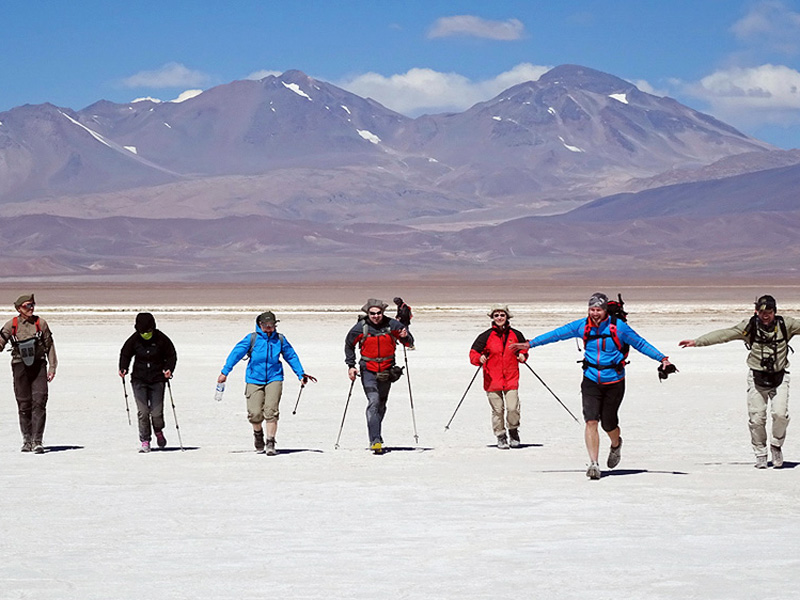
How do you train for the highest volcano on Earth?
Preparing for the Mountain of Extremes
Ojos del Salado is a mountain of extremes. Standing at an impressive 6,893 meters, it places significant demands on mountaineers. Our experts rate the technical difficulty as moderate, while the physical demands are considered high. Why is this? While there are no extremely difficult sections involving bare ice climbing, there is a stretch of easy, rope-secured scrambling just before the summit. The true challenge lies in the terrain and the physical exertion involved: you are moving through thin air across deep, energy-sapping volcanic ash, making excellent physical conditioning essential for the climb.
The Three Pillars of Your Training Plan
To withstand the extreme conditions of the Atacama Desert, your training should begin at least 4 to 6 months prior to the expedition and rest on three pillars
1. Basic Endurance (Aerobic Foundation)
You need a highly robust cardiovascular system to maintain performance for hours on end despite the lack of oxygen.
- Activities: Running, cycling, swimming, or rowing.
- Focus: Long, slow sessions (Zone 1/GA1). Train for duration rather than speed. A slow, steady run lasting 2–3 hours or a 5-hour road bike ride perfectly simulates the sustained exertion required on Ojos del Salado.
2. Strength Endurance (Legs & Core)
Walking through deep volcanic sand is like climbing an escalator moving downwards—every step requires leg strength. At the same time, a strong core stabilizes your body when carrying a heavy backpack.
- Exercises: Squats, lunges, deadlifts, and planks.
- Method: High repetition counts (20–25 reps) with moderate weight, or functional training using your own body weight.
3. Specific Training (Weighted Hiking)
Nothing prepares you better for an expedition than mountaineering itself.
- Activities: On weekends, seek out the steepest ascents in your local area. Go hiking and deliberately pack extra weight (e.g., water bottles) into your backpack (start with 10 kg and increase to 15–18 kg).
- Goal: Accumulating vertical gain over many hours to condition your muscles, tendons, and joints for the eccentric load of the descent.
Sample Training Plan: The final 3 months before departure
Use this structured routine to systematically bring your fitness to its peak:
Monday: Rest day – recovery & muscle building.
Tuesday: 60–90 min. base endurance (running/cycling) – cardiovascular system (GA1).
Wednesday: 45 min. functional strength training – core and leg strength.
Thursday: 60 min. Fartlek or interval training – increasing VO2max (oxygen uptake).
Friday: Rest day or light yoga/stretching – flexibility & recovery before the weekend.
Saturday: Specific training: Uphill hiking – 4–6 hours with a 12–15 kg backpack.
Sunday: 120 min. easy cycling or a long walk – active recovery & fat metabolism.
With this training foundation and our professional acclimatization strategy involving multiple high camps, you will be well-prepared to successfully sign the summit logbook of the world's highest volcano.