


Climbing the highest volcano on Earth
The technical climbing demands of Ojos del Salado (6,893 m)
Anyone planning an expedition to Ojos del Salado must carefully consider the extreme altitude of 6,893 meters and the physical challenges posed by the high-altitude Atacama Desert. Yet, alongside the need for endurance, another key topic frequently comes to the fore for our participants: what is the level of technical climbing difficulty involved in ascending the world's highest volcano?
While our experts rate the technical difficulty of the expedition as moderate overall, there is one specific crux—a challenging section just before the summit—for which you need to be prepared.
The crux—the 20-meter final section on the summit structure.
The long ascent across dusty slopes and energy-sapping volcanic ash pushes your body to its absolute limits. Yet, just before the actual summit, the terrain changes:
- Upon reaching the crater rim, the route leads into a gully characterized by prominent blocky terrain.
- Just before the summit, an easy climbing section—approximately 20 meters high—awaits the climbers.
- Although this stretch does not require extreme, acrobatic climbing skills or high-level technical ability, the passage—situated at an altitude of nearly 6,900 meters—should by no means be underestimated due to the extremely thin air.
The SPONDYLUS safety concept: double protection for summit success.
As a responsible expedition provider, we at Spondylus leave absolutely nothing to chance at this critical section. To guarantee maximum safety, a dual protection system is employed:
- Fixed rope protection: The entire 20-meter section is permanently equipped with a sturdy fixed rope that you can hold onto and use to pull yourself up.
- Additional top-rope protection: To completely eliminate any risk of falling in the steep, rocky terrain, our experienced mountain guides provide additional security for every participant using a dynamic rope from above (top-rope system).
For this reason, carrying and wearing a climbing harness and two carabiners is mandatory for all participants. While advanced climbing skills or formal alpine climbing training are not required to navigate this section, you must be comfortable and proficient in the use of the harness and carabiners, ensuring their handling presents no difficulty in practice.
Why the climbing helmet is indispensable
The rock in the volcano's summit area is exposed to the harsh Andean weather. Consequently, the climbing section described carries a slight risk of rockfall. As the safety of our guests and team is our top priority, wearing a certified climbing helmet is absolutely essential on this part of the expedition. The helmet provides reliable protection against loose rock that could be dislodged by climbers ahead of you or by strong gusts of wind.
Ice, snow, and the use of crampons
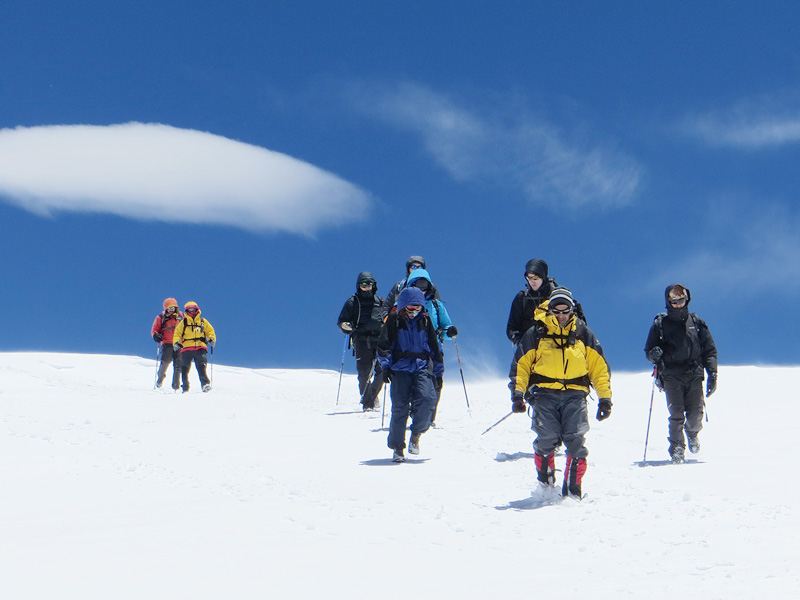
The weather on the "Roof of the Andes" can change rapidly, even in high summer. Depending on current snow and ice conditions, it may be necessary to traverse sections covered in snow or ice. While the use of crampons is not mandatory for every expedition—as the slopes are often completely dry—absolute proficiency in their use is a strict requirement for participation on safety grounds. You should have practiced and mastered walking in crampons beforehand to ensure perfect surefootedness at all times, even on slippery or hard terrain.
Safely to the summit with the right preparation
Ojos del Salado is not merely a trekking peak; the summit section demands genuine alpine discipline. While advanced technical climbing skills are not required, the flawless handling of your technical gear—comprising a harness, carabiners, climbing helmet, and crampons—is your personal ticket to a safe ascent.